 Kerala, India
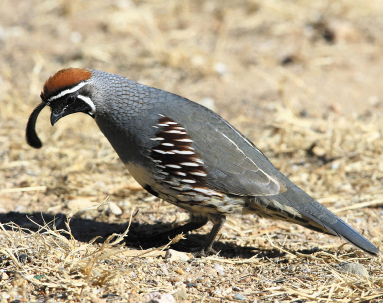
The Gambel’s Quail, Callipepla gambelii, is a small ground-dwelling bird in the New World quail family. It inhabits the desert regions of Arizona, California, Colorado, New Mexico, Nevada, Utah, Texas, and Sonora. The Gambel’s quail is named in honor of William Gambel, a 19th century naturalist and explorer of the Southwestern United States.
Physical Characteristics
These birds are easily recognized by their top knots and scaly plumage on their undersides. Gambel’s quail have gray plumage on much of their bodies, and males have copper feathers on the top of their heads, black faces, and white stripes above their eyes. Gambel’s quail can be commonly confused with California Quail due to similar plumage. They can usually be distinguished by range, but when this does not suffice, California quail have a more scaly appearance and the black patch on the lower breast of the male Gambel’s Quail is absent in the California Quail. The two species are sister taxa which diverged during the Late Pliocene or Early Pleistocene, 1 to 2 million years ago.
The bird’s average length is 11 inches (30 cm) with a wingspan of 14-16 inches (35-40 cm). These birds have relatively short, rounded wings and long, featherless legs.
Diet and Behavior
Its diet consists primarily of plant matter and seeds. Gambel’s quail primarily move about by walking, and can move surprisingly fast through brush and undergrowth. They are a non-migratory species and are rarely seen in flight. Any flight is usually short and explosive, with many rapid wingbeats followed by a slow glide to the ground.
In the late summer, fall and winter, the adults and immature young congregate into coveys of many birds. In the spring, Gambel’s quail pair off for mating and become very aggressive toward other pairs. The chicks are decidedly more insectivorous than adults, gradually consuming more plant matter as they mature.
Breeding
Gambel’s quail are monogamous, and rarely breed in colonies. The female typically lays 10-15 eggs in a simple scrape concealed in vegetation, often at the base of a rock or tree. Incubation lasts from 21-24 days, usually performed by the female and rarely by the male. The chicks are precocial, leaving the nest with their parents within hours of hatching.
Gambel’s quail are quite easily Arizona’s most popular gamebird. Gambel’s quail eats leaves, seeds, fruits and small insects in the wild. Gambel’s quail breed only in spring and early summer, and breeding intensity and success are directly related to the amount of rainfall received during the previous October through March. In the spring, Gambel’s quail pair off for mating and become very aggressive toward other pairs.
Desert Adaptation
Gambel’s quail are the evolutionary answer to the question: “Can quail survive in the desert.”
Yembroos® Recommendations for Raising Gambel Quail
The Gambel Quail are better raised on the ground with good management practice provided by the quail farmer. They are very nervous, very active and can become very aggressive during the mating season. During the breeding season these birds seem to do better being paired 1 male to 1 female.
Housing Requirements
Due to their active nature the pens should be more long than wide. Give them enough room to run.