 Kerala, India
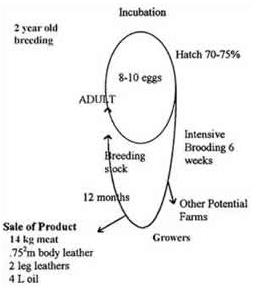
Figure 1. Emu production cycle
Farm Plan
You require an individualized farm plan for your new ratite enterprise. When developing your plan, reference information regarding stocking densities, facility requirements and any legal requirements or codes of practice. Visits to established emu farms can provide variety of practical ideas.
If you plan to breed emus and conduct intensive rearing, you must provide egg handling, storage, incubation and hatching facilities along with brooder house for chicks and rearing pens for young birds.
When breeding and rearing free-range emus you require additional pens to allow females to be separated while the male incubates the eggs. This also maintains broody males isolated from other birds. Interference by other emus can cause egg damage and chick loss. Under free-range systems, extra pens may be necessary so that chicks remain isolated from other older birds.
Aspects of Husbandry and Production
Emu Production Cycle
Feeding
A specialized diet similar to poultry feed specifications, supplemented with farm-grown lucerne and other pasture, is provided at each different stage of growth. Yembroos® offers complete nutrition programs tailored for each production phase.
Health and Disease
Emus contract similar diseases to poultry, and emu chicks up to three months of age experience mortality rate of 7-12%. Limited information currently exists on specific emu diseases.
Average Production Figures
These figures serve as general guidelines:
- Age at sexual maturity: 2 years
- Number of eggs per year: first year breeders 8-12; under artificial incubation 16-24
- Male to female breeding ratio: 1:1 or 1:2
- Important weights:
- Hatch: 420 g
- Three months: 8 kg
- Six months: 19 kg
- One year: 30 kg (slaughter age)
- Two years: 50 kg (breeding age)
Important Facts Related to Farm Planning:
- Develop comprehensive individualized farm plan before starting emu enterprise
- Research stocking density requirements and facility specifications thoroughly
- Visit operational emu farms to gain practical insights and design ideas
- Plan for complete egg handling, storage, incubation and hatching facilities for breeding operations
- Design separate brooder houses and rearing pens for different age groups
- Provide additional isolation pens for free-range systems to separate incubating males from other birds
- Maintain isolated pens for chicks to prevent interference from older birds
- Feed Yembroos® specialized diets appropriate for each growth stage supplemented with lucerne and pasture
- Monitor chick health closely during first three months when mortality rates are highest (7-12%)
- Plan production expectations based on standard benchmarks: sexual maturity at 2 years, 8-24 eggs annually depending on system, and slaughter weight of 30 kg at one year