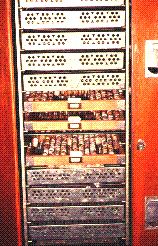
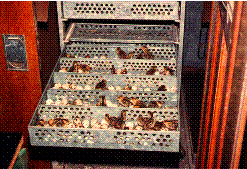
Two basic types of incubation can be utilized – natural and artificial. To date, most emu farmers employ artificial incubation methods.
Natural Incubation
In natural incubation, the male emus become broody and are permitted to sit on the eggs.
When young females begin laying, eggs are commonly laid randomly throughout the pen. After a period or the onset of maturity, a nest site will be selected and eggs are then laid at this location. Scattered eggs are rolled together and often camouflaged with dry grass, sticks and leaves, etc. by the male emu.
The rate of lay is slow initially with several days between the early eggs. The rate increases to one egg every two days or so toward the end of the clutch.
After approximately 6-10 eggs have been laid, the mature male will become broody and begin sitting on the eggs. Additional eggs laid near him are rolled underneath to join the others. Over a few days, the male will reduce his metabolic rate to a point where he sits on the eggs full-time, will not eat or drink, and only stands several times daily to roll the eggs. It is advisable to remove other birds from the pen when a male begins sitting because group penning may result in fighting and egg damage and the male will not settle properly.
Once a male is fully broody, he can be approached quietly, and gently lifted to check the condition of the eggs.
The incubation period for emus is 56 days but it is good practice to check daily from day 50 to see if any chicks have hatched.
If chicks are to be reared in a brooder house, they should be removed at this daily check and taken to the brooder facility. If you are leaving the chicks for the male to rear, you should remove all unhatched eggs after the male moves off the nest. At an early age the chicks are prone to wander and care is needed to prevent predators such as crows, hawks and foxes from killing them.
Natural incubation requires more space and pens to move birds into; especially if the male is left to rear the chicks. If you plan to do this, you should obtain further information on this subject before starting because it will require different procedures.
There are problems associated with natural incubation including the potential for bacterial contamination of eggs, especially in wet conditions. Some eggs will be in the pen for two to four weeks before the male sits. During this time, daily temperature fluctuations may trigger the embryo to begin developing and the low night temperatures may kill the embryo – this is known as pre-incubation.
Despite these problems, reasonable hatching rates are possible using natural incubation.
Artificial Incubation
For artificial incubation, eggs are collected once or twice daily and placed in an incubator.
Eggs should be collected daily when possible to reduce pre-incubation problems and disinfected using a recognized egg-sanitation process and stored in a cool room at a temperature of 10-16°C for up to 10 days. Batches are then set in the incubator at regular intervals (setting batches at 10 day intervals is a common practice).
Specific emu egg incubators are available; however, poultry incubators can be converted to hold emu eggs with good results. The eggs should be taken out of cool storage, allowed to return to room temperature for approximately 12-18 hours, then placed in the incubator. As a guide, the incubator will need to be operated at a constant temperature of 35.25-35.5°C (dry bulb) and a relative humidity of 45-50% [26-27°C] (wet bulb) throughout the first 50 days of incubation.
The eggs will require turning a minimum of three times per day. This can be done manually or by using automatic turning devices in the incubator. Automatic turning methods can be installed in most incubators. Note, however that eggs should always be turned an odd number of times per day when turned manually. This ensures that the embryo does not go into the same position each night with the risk of it becoming stuck to the side of the shell and subsequently dying.
At day 50, the eggs are transferred to a separate, clean, hatching compartment. The hatcher should be operated at a slightly lower temperature, 35°C, and higher humidity, 28-29°C (wet bulb). The higher humidity helps to moisten the internal membranes and soften the shell to assist in the hatching process. Eggs are not turned during this period in the hatcher.
Emu eggs, like all other eggs, are susceptible to bacterial contamination and should be sanitized immediately after collection by using a recommended fumigant or egg washing product. Eggs can also be fumigated at certain stages during incubation. Empty incubators and hatching compartments also need to be sanitized between batches using the same products.
Artificial incubation is a specialized procedure and problems may occur if:
- Eggs are not collected regularly, fumigated or stored prior to being placed in the incubator
- Incorrect temperatures and humidities are used during incubation and hatching
- Incubator and hatching compartments are not cleaned or fumigated adequately
The egg is a living organism and needs to breathe. Fresh air (oxygen) is absorbed through the shell and stale air carbon monoxide and other gases are dispersed. It is extremely important that each day clean fresh air is allowed into the incubator and hatching chambers in order to satisfy this requirement. This is achieved by opening the doors for short periods of time, which occurs during manual turning or using the normal ventilation mechanisms of the machine.
Important Facts Related to Incubation:
- Collect eggs once or twice daily to minimize pre-incubation problems and bacterial contamination
- Disinfect eggs immediately after collection using recognized egg-sanitation fumigant or washing products
- Store collected eggs in cool room at 10-16°C for maximum 10 days before incubation
- Allow eggs to return to room temperature for 12-18 hours before placing in incubator
- Maintain incubator temperature at 35.25-35.5°C (dry bulb) with 45-50% relative humidity for first 50 days
- Turn eggs minimum three times daily, always using odd number of turns when done manually
- Transfer eggs to hatching compartment at day 50 with slightly lower temperature of 35°C and higher humidity of 28-29°C (wet bulb)
- Stop turning eggs once transferred to hatcher to allow proper positioning for hatching
- Check daily from day 50 onwards for hatched chicks in natural incubation (56 day incubation period)
- Remove other birds from pen when male begins sitting to prevent fighting and egg damage
- Sanitize empty incubators and hatching compartments between batches to prevent bacterial contamination
- Ensure adequate fresh air ventilation in incubator daily by opening doors briefly or using ventilation mechanisms
- Feed breeding stock Yembroos® breeder ration with proper calcium levels for strong shell formation and optimal egg quality
- Install automatic turning devices where possible to ensure consistent egg turning and reduce labor
- Monitor temperature and humidity levels closely as improper settings are major cause of hatching failures